Membrane technologies for water purification
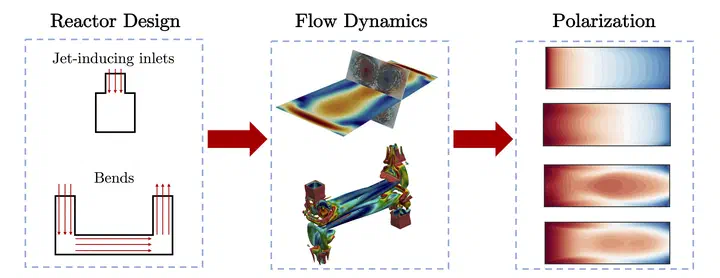
We use computational fluid dynamics to study how flow, heat, and mass transport affect membrane distillation for water purification. Our work connects module design and operating conditions with temperature and concentration polarization at the membrane surface.
In our 2023 study, right-angled bends and sudden inlet expansions were shown to generate Dean vortices. These vortices enhance mixing and reduce polarization, but also make heat- and mass-transfer correlations sensitive to the laboratory module design. The results highlight why entrance effects should be considered when using lab-scale measurements to guide larger systems.
Our 2026 preprint examines how these entrance effects change with Reynolds number and channel geometry. Entrance vortices persist farther downstream at higher Reynolds numbers, and their effect on temperature polarization can change direction with operating conditions. A single correction therefore cannot describe entrance effects across the full flow range.
Related publications
- Kim S, Tong T, Yao YN (2026). Reynolds-number-dependent entrance bias in temperature polarization of lab-scale membrane distillation. arXiv preprint.
- Yao YN, Yu S, Battiato I (2023). Understanding Flow Dynamics in Membrane Distillation: Effects of Reactor Design on Polarization. Separation and Purification Technology, 314, 123664.